

Back in 2018, I started tracking political “unicorns” – governors and U.S. Senators who won elections despite the state being strongly in favor of the other party. Here’s an updated chart that shows how the number of unicorns has changed over the last 10 years:
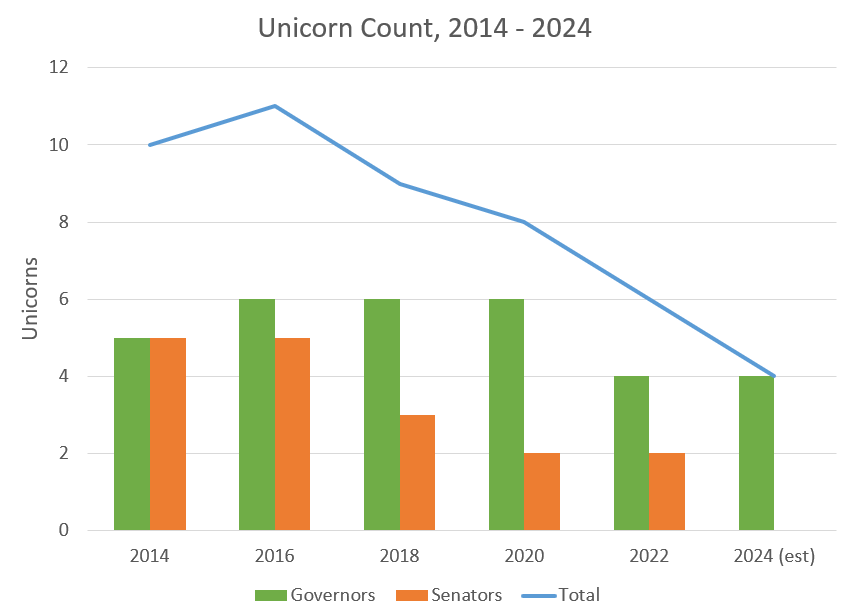
The number of governors has dropped a bit – from 6 in 2020 to 4 now (all of whom are expected to keep their seats in 2024). The real change has come from the U.S. Senator side – from 5 in 2016 to 2 now, and likely 0 after the 2024 elections – Joe Manchin (D-WV) isn’t running, and Jon Tester (D-MT) is behind by 7 points in the latest polls.
This is disappointing – these unicorns usually have to be moderate/centrists, in order to keep office, and their presence is a sign that voters are able to see past what’s frequently the national party message; that the other party is made up of extremists. But it isn’t a surprise – ticket-splitting (voting for candidates from different parties on the same ballot) is becoming more and more rare. Senators get sucked into votes on national partisan issues, while governors are more able to focus on local state issues.
The four unicorn governors remaining:
- Phil Scott, R – Vermont (since 2016)
- Laura Kelly, D – Kansas (since 2018)
- Andy Bashear, D – Kentucky (since 2020)
- Glenn Youngkin, R – Virginia (since 2021)