



by JAY WILDER – November 17, 2020
There have been a lot of stories and theories recently about voter fraud in the presidential election, often with little to no evidence. I’d like to share my Election Day experience as a poll observer in Milwaukee. It wasn’t as dramatic as malicious software, sacks of mysterious ballots, or dead people voting, but it taught me a good lesson about the more-subtle ways that voter suppression can happen.
On Election Day, my wife and I volunteered to be poll observers in Wisconsin, and one of our polling locations was the Milwaukee Police and Fire Safety Academy. We were there off and on until about 1PM. Our experience was troubling; here’s why:
Visible Police Presence
First, why was a police academy selected as a polling location? I emailed our Wisconsin-based organizers to ask if they knew the history, but didn’t hear back. I think it was an inherently bad choice. It’s no secret that police unions across the country have overwhelmingly supported Trump, and Milwaukee is no exception – the union publicly endorsed Trump in August. And when you factor in the recent shooting of Jacob Blake in nearby Kenosha and the subsequent protests, and consider that the 18th and 19th wards (which this polling location served) are 68% Black, the city’s choice seems especially questionable.
In our poll watching training, they told us to watch out for any unnecessary police presence at the polls that could be intimidating to potential voters. There’s no getting around it—there’s going to be a police presence at a police safety/training academy. I will note that most of the police officers and trainees were out of uniform and not loitering near the polling entrance. But there were a few occasions where there were police vehicles parked right in front of the polling entrance for 15 minutes or more, with officers in uniform nearby. Do I think that some voters, once they arrived, changed their minds about voting when they saw the police presence? Possibly. But even more likely is that there were some voters who simply chose to stay home rather than take the chance of a difficult encounter.
Limited Parking
The parking lot had over 100 spots; every one had a “Reserved” sign at the head of it. By my count, only 14 of the spots had orange wrappings around the signs that read: “Temporarily reserved for voting.” The Academy is in an industrial/commercial area; its neighbors are a trucking company, industrial supply store, and an auto-body shop. There’s nothing residential in the immediate area, so every voter that I saw arrived by car. The limited parking spots filled up quickly, especially during the busiest hours (there are roughly 2,500 people of voting age in the ward). And remember, we all knew this would be a high-turnout election. I noted a few times when the voting parking spaces were all full, forcing people to make the decision to either drive around for several minutes and wait for one to open up, or park in the Reserved spots and chance a ticket (at a police academy, no less). I decided to take a chance and park in a Reserved space rather than take up one of the orange spaces. Could there have been people who arrived, were frustrated by having to drive around waiting for parking, and decided to leave? Again, possibly. But there weren’t many cars taking up the other “reserved” spots – why wouldn’t they have set aside thirty spots instead of fourteen?
No Signs or Directions
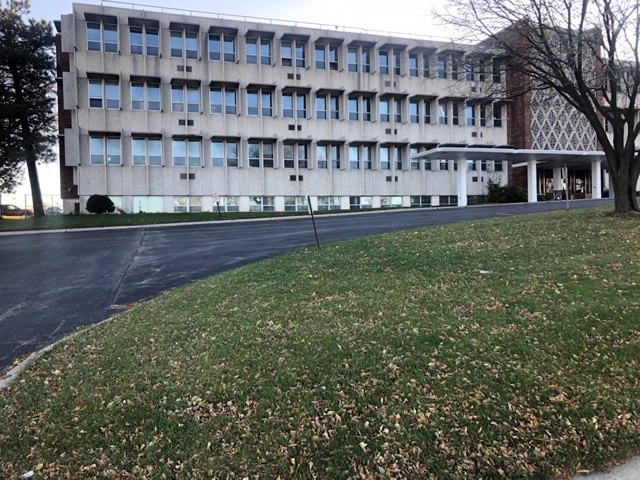
This was the biggest issue on election day. The people running the polling location (a mix of election officials and police officials) made zero effort to indicate that the building was a polling location, or to guide people to the polling entrance in the back. We were confused from the start; we drove past the building a few times, looking for signs before turning into the driveway. We pulled into the driveway in front of the building just after voting started (so a time of day when a lot of people were expected to vote) but there was no one out front, no signs on the front door, nothing that indicated there was an election happening that day and that this was a place to vote. We continued along the driveway to a side entrance, but still nothing. Thinking we just had the wrong address and there must be another building further down the street, we went back onto the road, but soon realized that had to be it. When we pulled back into the driveway we spotted an offshoot on the left, curving around into a fenced-in area behind the building. We followed it, and sure enough, found a few dozen parked cars and a small sign outside the back door, about four feet tall and a foot wide, that identified it as the polling station.
We decided that the most important thing we could do that day would be to make sure people arriving at the building knew that this was the correct place and how to get to the polling location in back. There were certainly going to be people new to the neighborhood, or first-time voters, that had never been there before and could use some guidance. But over the next few hours, our actions caused a number of conversations and confrontations with police officials (a lieutenant and a captain):

- When we put up signs along the driveway offshoot, the police asked us to take them down because our signs had a small Biden/Harris logo on them. This happened despite the fact that the election judge had previously come out and OK’d them because they were more than 100 feet from the poll entrance (“electioneering” is only prohibited within 100 feet).
- When we moved them across the street so that people driving by on the main road could at least be reassured this was a polling location, they made us take them down because they were on “public property.” Even though there were candidate signs on public property everywhere else in the city.
- We took blank posterboard and made nonpartisan “Vote Here” signs with an arrow; they would not let us plant those, saying that they hadn’t been approved by an internal group at the Police Academy. Feeling pressured to do something, they put up their own voting “signs” which consisted of standard sheets of paper taped to a few poles on the way up the driveway offshoot. They were barely noticeable to someone driving by, especially as the wind wrapped the paper around the poles. One was even facing the wrong direction, only visible to people leaving the lot.
We spent a lot of time that morning in a back-and-forth with the lieutenant and captain, discussing sign placement. The conversations got tense enough that, early in the afternoon, our organizers pulled all volunteers from the location for the rest of the day, replacing us with more experienced, paid officials.
Overall, nothing the police officials did was illegal, but when you ask if they make a reasonable effort to make sure voters had a good experience, I think the answer is a resounding “No.” For future elections, we could have conversations with election and police officials about having better signs, more parking set aside, and less of a visible police presence. But that doesn’t solve the underlying problem of voters—particularly Black and immigrant voters—feeling uncomfortable going to a police academy to vote. A quick check of Google Maps shows about a dozen schools and churches in the neighborhood. My goal is to see if we can find a new polling location for the next election.
Jay – this is super interesting thanks for posting this.
Super insightful to take a real example to give people some context for how challenging it was for people to vote. The beauty of this story is that it is against the backdrop of the largest election turnout ever and speaks to the resiliency of the American people during these turbulent times.
Really interesting, Jay and Chanda. Thank you for what you did! We all need to be more aware and active.